
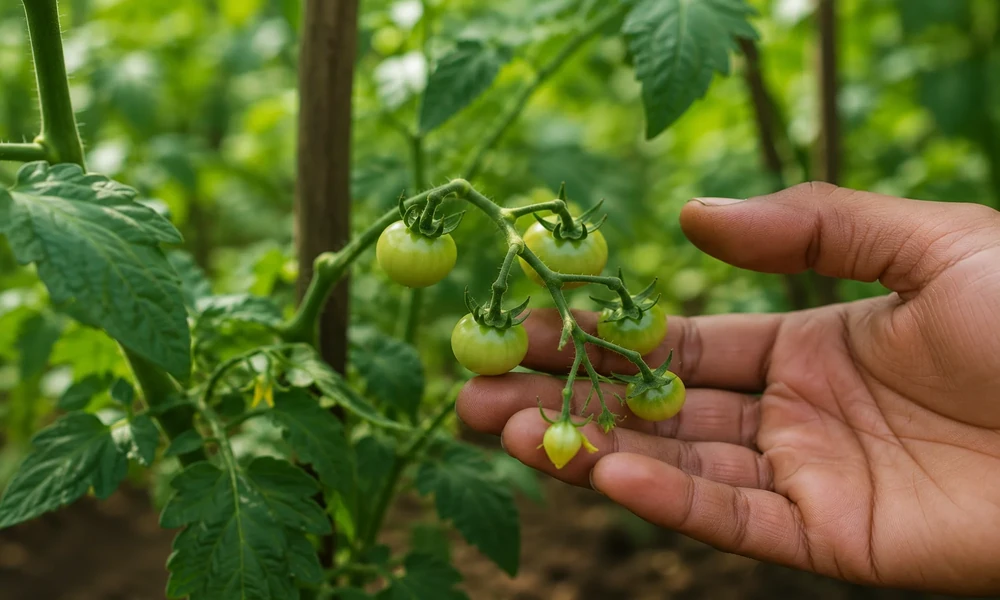
Place an empty bowl where you would put the harvest. Reach towards the proposed fruit plant. Now imagine doing that movement several dozen times, with leaves and branches occupying the space between you and the berries. Where does it become awkward?
That is the problem to solve. Perhaps the lowest fruit would require uncomfortable bending. Perhaps the plant would sit beyond a bed you cannot approach closely. Thorns could be the main obstacle, or canes crossing the path. Different plants address different parts of the movement, so “easy to pick” needs a meaning specific to you.
The UK suppliers below offer named thornless cultivars, contrasting cane habits and raised forms of soft fruit. Use their descriptions to picture the harvest position. A small plant on arrival gives you something to develop; its future arrangement determines the reach.
Looking at the hand’s route to the fruit
For this selection, cultivar identity comes first where thornlessness matters. Habit, support and the position of the fruiting growth come next. The published offers establish what can be bought; the suggested movements help translate those features into a garden arrangement.
The order moves through soft-fruit options and brings in a raised currant crown as a distinct approach. There is no single accessibility ranking that would suit every reader. A low berry may be convenient for one person and tiring for another. Evaluate each feature against your own comfortable position, whether standing or sitting.
Keep three measurements separate: the plant’s delivery size, the eventual extent of its growth and the distance to the fruit. A tall cane can be tied along a support. A low pot can still hold a plant that will become broad. Only the last measurement tells you how far your hand must travel.
Top 10 UK suppliers with fruit plants to assess for easier picking
1. Chris Bowers & Sons
Waldo blackberry, offered by ChrisBowers for British gardens, removes prickles from the reach into the canes. It is a thornless cultivar with a compact trailing habit, supplied as a young two-litre plant. Those details suggest a starting arrangement: smooth stems directed along a support you can approach closely.
Try the position before planting. Reach to each end of the intended wire or frame. Move the bowl with you. If a corner becomes awkward, shorten the useful picking span on your plan; growth tied beyond it would put fruit into the difficult part again. Leave enough room below and beside the support to manage new canes as well as harvest from the older arrangement.
Ben Sarek blackcurrant offers a different movement from the same nursery. Its catalogue allows closer spacing for this compact cultivar than for the larger blackcurrant bushes. Your hand would travel around a bush rather than along trained blackberry canes. For a shallow bed, that distinction gives a reason to compare Ben Sarek with Waldo before buying either. Lower fruit still needs reaching; compactness does not raise the crop.
The young plants leave scope to establish that layout from the beginning. Keep the approach clear while growth develops. A few accessible fruiting stems can give more practical pleasure than a heavily stocked corner that requires stretching across its neighbours.
2. Pomona Fruits
How much of your support can you actually use? Pomona’s Waldo blackberry and LY654 loganberry are both thornless, but their space requirements differ. The supplier allows roughly half as much spacing for compact Waldo as for the larger hybrid.
Measure the approachable length. Exclude the part behind a seat, beyond a deep border or around a corner that interrupts your movement. That usable length gives the cultivar comparison a purpose. Waldo may fit the smaller arrangement; LY654 needs its greater extent allowed for. Follow the selected plant’s spacing and training advice when laying out the support. Buying the larger-growing option commits you to reaching and managing a larger area, even though both have smooth stems.
3. Marshalls Garden
Autumn Treasure brings pruning into the access question. Marshalls lists this thornless primocane raspberry, which fruits on growth produced in the current year. For the usual single autumn crop, the canes are cut down in late winter.
Imagine that second job as well as picking. Can you get close to the bases along the whole row? Is there somewhere to put the removed canes? A clear approach supports both tasks. Marshalls lists five- and ten-root packs for November preordering; the four-litre alternative was sold out when checked. Settle the row length before choosing the quantity. A pack of extra canes is extra planting space to maintain. Smooth stems help during the harvest, and a reachable row makes the renewal routine more manageable too.
4. Crocus
Ben Connan blackcurrant brings the choice closer to an ordinary bush. Crocus describes a small to medium shrub with large berries, offered in a three-litre pot and through seasonal bare-root options. There is no tall clear stem beneath its crown. This is a different starting arrangement from Blackmoor’s half-standard immediately below.
For someone comfortable reaching lower fruit, the relatively contained bush may suit a position beside a path without requiring a run of wires. Someone trying to avoid bending should examine the raised form instead. Crocus’s single potted plant lets the smaller purchase remain small; a bare-root multibuy adds bushes and therefore additional positions. Choose the structure first, then the quantity. The fact that berries are large is useful to consider, but it cannot establish whether the whole bush will fall within your comfortable reach.
5. Blackmoor Nurseries
Mark ninety centimetres on a post. This is the clear-stem height described for Blackmoor’s Titania blackcurrant half-standard. The fruiting crown begins above it, and the listed half-standard arrives in a ten-litre pot.
Now assess the space above your mark. Lifting the crown could bring the lowest berries closer to a comfortable picking band. It also places the upper branches higher, so try the reach around the whole imagined head. Assess from the position you expect to use, including the room needed for your bowl.
A standard currant needs staking. Include the stake in the layout and leave access around the head. Blackmoor also offers Titania in conventional bush form, making the comparison particularly clear: the cultivar can stay the same while its fruiting structure changes. Choose between those structures according to the movement that you want to improve.
6. Thompson & Morgan
Some picking spaces suit upright growth. Thompson & Morgan offers the thornless blackberry Navaho, described with an upright habit, in a two-litre pot. If trailing canes would cross the approach, that habit deserves consideration.
Look at width as well as height. Even upright stems can crowd together, leaving inner fruit awkward to reach. Plan room to manage the developing plant and follow the cultivar’s support and pruning guidance for the site. The useful question is where its fruiting growth can be maintained comfortably. If your preferred picking band is above ground level, upright structure may help. The arrival height of the pot-grown plant is only the beginning of that arrangement.
7. J. Parker’s
Read all three names in J. Parker’s hybrid-berry collection. Merton Thornless blackberry and a thornless loganberry appear alongside a tayberry. The three plants are supplied in two-litre pots. Two components are specifically identified as thornless; that wording cannot be extended to the third.
If avoiding scratches is central to the purchase, assess the tayberry separately before accepting the bundle. Each plant needs a reachable position and appropriate support, and a mixed collection gives you several growth patterns to accommodate. Starting sizes also vary between the retailer’s offers. A larger pot can alter the initial handling task, but the cultivar remains the basis for checking spines. Keep the individual labels with the plants so that their different needs remain clear after unpacking.
8. Roots Plants
Ruby Beauty gives Roots a distinct place in this list. It is a compact summer-fruiting raspberry offered in three-litre pots, singly or in a group of three. The description calls it almost completely thornless, a useful qualification to retain when smooth stems are the reason for the enquiry.
The plant fruits on canes carried through from the previous year. Its renewal routine therefore differs from the usual single autumn crop of Autumn Treasure at Marshalls: the fruited Ruby Beauty canes are removed while new canes are retained. A low, compact plant still leaves work near the base, so picture that movement as well as the harvest.
The listing was out of stock when consulted. This is a precise future enquiry for a small container or limited planting space, with current availability to resolve. It adds a different raspberry arrangement to the shortlist, rather than another source of the same trailing blackberry.
9. Victoriana Nursery Gardens
Buckingham is the tayberry name to look for at Victoriana. It identifies the specifically spineless form, giving a precise way to request smoother canes. Other tayberries should be checked on their own descriptions.
The nursery describes the ripe fruit as pleasantly sharp. This makes the choice about a berry you want to eat as well as the stems around it. Allow fruit to ripen properly, and reserve an accessible length of support for the pot-grown plant to extend along. Its advertised sixty-centimetre height includes the pot, so that starting measurement should not set the length of the frame. Smooth canes remove one obstacle to handling. Keeping their fruiting growth near the approach allows you to benefit from that feature. As new growth develops, retain enough space to distinguish and manage the stems without reaching through a dense mass.
10. Buckingham Nurseries
An awkward corner can call for one carefully chosen plant. Buckingham Nurseries lists Waldo and Merton Thornless blackberries in its mail-order range, providing named options for that smaller purchase.
Take the measurements of the usable support to an enquiry: reachable length, comfortable height and the depth between you and the future canes. Ask about the cultivar and supplied format appropriate to the intended planting time. This keeps the conversation tied to the corner you are trying to improve. A description such as “easy fruit” leaves too much unexplained; dimensions and a specific plant name give the nursery something concrete to respond to. Settle the position first, then confirm current availability.
Choose the height that suits your reach
Return to the empty bowl. Put it where it will stand during picking, then try the movement to your marked fruiting height. Check sideways reach and depth too. A berry directly in front of you presents a different task from one at the same height across a wide bed.
Leave space for the mature branches, the support and your own approach. Try moving along the whole proposed planting, including its ends. The arrangement should still work when leaves fill the frame and the bowl contains fruit. These small checks make a nursery description easier to judge: you can picture the plant doing a particular job in a space that you can use.
Source note: Supplier descriptions identify the cultivars, thornlessness and starting forms discussed here. RHS guidance supports the distinction between the usual autumn-raspberry pruning routine and other cropping systems.